History of Minesweeper
How a little puzzle from a 1990 games pack became one of the best-known computer games ever made, why it once came with nearly every PC and where it went after Windows let it go.
The short version. Minesweeper first came out on October 8, 1990, in Microsoft Entertainment Pack 1 for Windows. It was made by two Microsoft programmers, Curt Johnson and Robert Donner. From 1992 it came free with Windows 3.1, and it stayed part of Windows until Windows 8 dropped it in 2012.
Minesweeper timeline
| Year | What happened |
|---|---|
| 1983 | Mined-Out for the ZX Spectrum has players cross a minefield, guided by a count of nearby mines. |
| 1990 | Minesweeper comes out on October 8 in Microsoft Entertainment Pack 1 for Windows. |
| 1992 | Windows 3.1 includes Minesweeper for free. It takes the place of Reversi. |
| 1999 | The International Campaign to Ban Winmine asks for the mines to go. |
| 2000 | A paper in The Mathematical Intelligencer proves that Minesweeper is NP-complete. |
| 2000 to 2001 | Some language versions of Windows 2000, ME and XP come with Flower Field, a version with flowers. |
| 2007 | Windows Vista brings a new look by Oberon Media, with a flower garden as an option. |
| 2010 | Kamil Murański clears Expert in 31.13 seconds. The record stands for ten years. |
| 2012 | Windows 8 leaves Minesweeper out. It comes back as a free app with ads. |
| 2014 | Guinness World Records lists Kamil Murański's 38.65 seconds for all three levels together. |
| 2020 | Ze-En Ju, aged 12, becomes the first player to clear Expert in under 30 seconds. |
| 2022 | Ze-En Ju sets the Expert record that still stands on the world ranking: 26.59 seconds. |
| 2025 | The Minesweeper World Championship is held in Madrid. |
Before Windows: earlier minefield games
Minesweeper didn't come out of nowhere. Games about crossing a minefield were around in the early days of home computers.
The best-known one is Mined-Out, written by Ian Andrew for the ZX Spectrum in 1983. You walked across a minefield, and the game told you how many mines were right next to you. Sound familiar? The pieces of Minesweeper were already there. They just hadn't been put together in quite the same way.
1990: a game in a games pack
Minesweeper was made at Microsoft by Curt Johnson, who first wrote it for IBM's OS/2. His colleague Robert Donner brought it over to Windows.
It came out on October 8, 1990, as part of Microsoft Entertainment Pack 1, a collection of small games for Windows. Microsoft wanted Windows to look appealing for homes and small offices, not just for big companies. Many games in the packs were made by Microsoft staff in their spare time.
1992: free with Windows
The big moment came two years later. Windows 3.1 came with Minesweeper built in, where Windows 3.0 had Reversi. From then on, nearly every new PC came with Minesweeper, right next to Solitaire.
It's often said that the two games had a job to do: Solitaire got people used to dragging with the mouse, and Minesweeper taught precise clicking and the right mouse button. Whatever the reason, it worked.
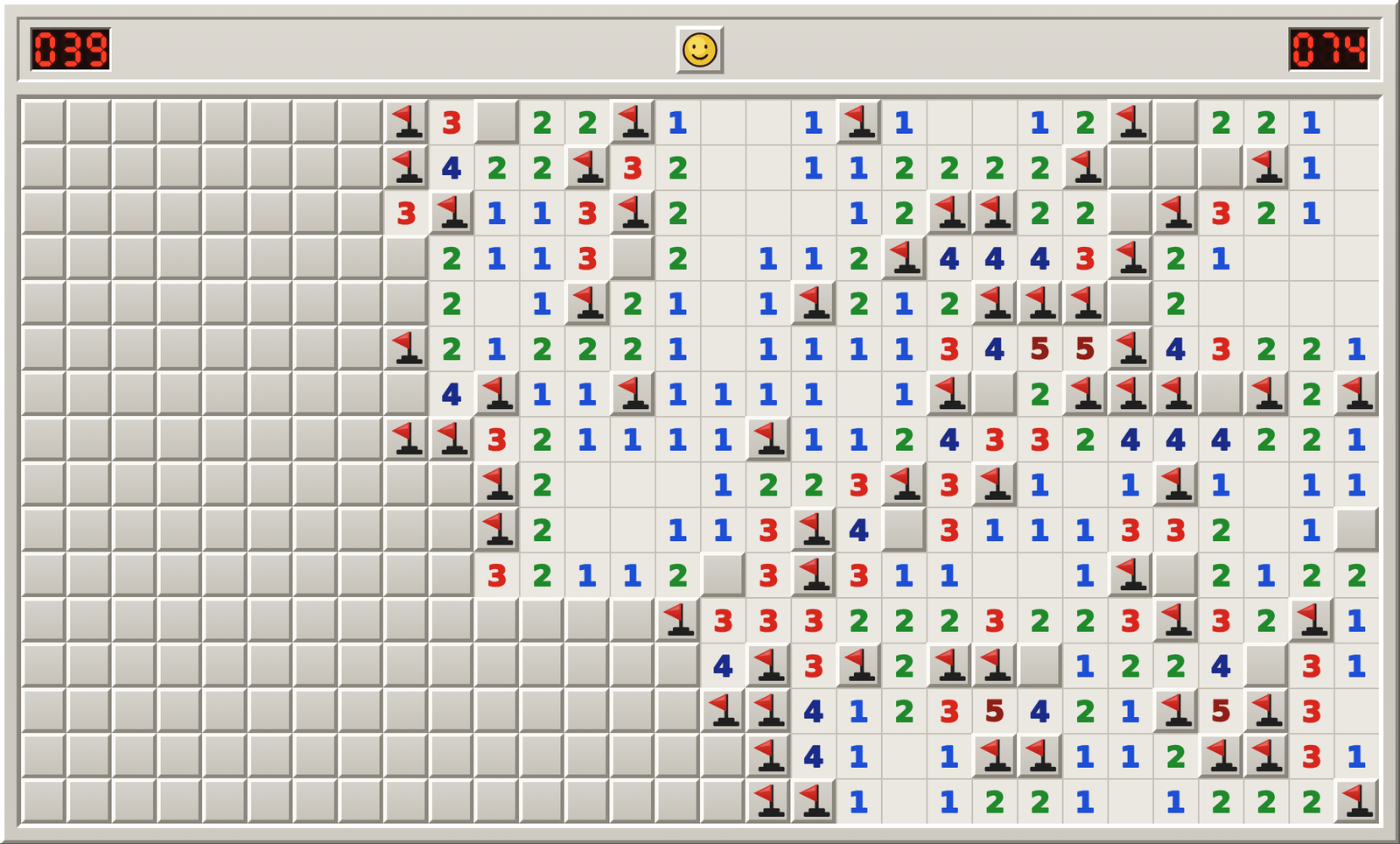
The game barely changed for the next fifteen years. The gray squares, the red counters and the smiley became part of the furniture. Beginner started out as an 8 × 8 board and grew to 9 × 9 in later versions like Windows XP. The official world rankings still use the original 8 × 8.
Flowers instead of mines
In 1999 a group calling itself the International Campaign to Ban Winmine argued that a game about mines was insensitive to the many people hurt by real landmines. It proposed flowers instead.
Microsoft listened, at least in part. Some language versions of Windows 2000, Windows ME and Windows XP came with Flower Field: the same game, with flowers in place of mines.
A new look in Vista
Windows Vista gave Minesweeper its first real makeover. The new version was made by Oberon Media, with shiny squares in the style of the rest of Vista and a flower garden theme as an option. In some countries the flowers were even the default.
Windows 7 kept this version. It would be the last Windows to come with Minesweeper built in.
Windows 8 and the Microsoft Store app
With Windows 8 in 2012, Microsoft stopped including its classic games. Minesweeper returned as a separate app in Microsoft's store, made by Arkadium. It was free, but with ads.
The app added new modes, like an adventure mode and daily challenges, and later a paid subscription to remove the ads. It's still there today as Microsoft Minesweeper. Many players, though, missed the simple old game that just started when you clicked it.
Minesweeper and mathematics
Minesweeper also caught the eye of mathematicians. In 2000 a paper in The Mathematical Intelligencer, titled "Minesweeper is NP-complete," showed that the game belongs to a famous family of hard problems.
In plain words: nobody knows a method that stays fast as boards get bigger, even just to check whether a position is possible at all. Finding one would crack a whole family of other hard problems too. It's one of the big open questions in computer science, with a million-dollar prize for whoever settles it.
On a normal board you don't need to worry about any of that. You also don't need to worry about boards that can't be solved without guessing, at least on this site. More about that on our page about no-guess Minesweeper.
The race for speed
Almost as soon as Minesweeper had a timer, people started racing it. The first records were measured in whole seconds, just like the Windows timer. Later records use programs that time to the hundredth of a second, and players share recordings of their games to prove them.
Kamil Murański from Poland cleared Expert in 31.13 seconds in 2010, a record that held for ten years. In 2014 Guinness World Records listed his 38.65 seconds for all three levels together. Then came Ze-En Ju from China, who broke the 30-second barrier in 2020 at the age of 12 and later got Expert down to 26.59 seconds.
See all the current times on our page about Minesweeper world records.
Minesweeper today
Minesweeper is more than 35 years old, and people still play it every day. Google added a version to its search results, and you can play it in any browser, like right here on this site.
Our version keeps the look and the feel of the classic game, with a few modern touches: boards that never need a guess, a hint that explains the next move and statistics for every level. Play Minesweeper and see if you still have it.
Questions and answers
Who invented Minesweeper?
The Windows game was made by Microsoft programmers Curt Johnson and Robert Donner. Earlier games used similar ideas, most famously Mined-Out from 1983 by Ian Andrew.
When did Minesweeper come out?
On October 8, 1990, in Microsoft Entertainment Pack 1 for Windows. It came free with Windows 3.1 from 1992.
How old is Minesweeper?
Minesweeper came out on October 8, 1990, so it turned 36 on October 8, 2026.
Is Minesweeper still on Windows?
Not built in. Windows 7 was the last version to include it. On Windows 10 and 11 you can get the Microsoft Minesweeper app from the Microsoft Store, which is free with ads. Or play the classic version right here in your browser.
What happened to Minesweeper in Windows 8?
With Windows 8, Microsoft stopped shipping its classic games as part of Windows and offered new versions as separate apps in its store instead.
Why are there flowers in some versions of Minesweeper?
After a 1999 campaign argued that a game about mines was insensitive to landmine victims, some language versions of Windows replaced the mines with flowers. Windows Vista also offered a flower garden theme.
Play the classic, right in your browser.
Play Minesweeper