Minesweeper patterns and tips
Fast players don't work out every square from scratch. They recognize shapes they've seen a hundred times before. Learn the patterns on this page and most boards will start to solve themselves.
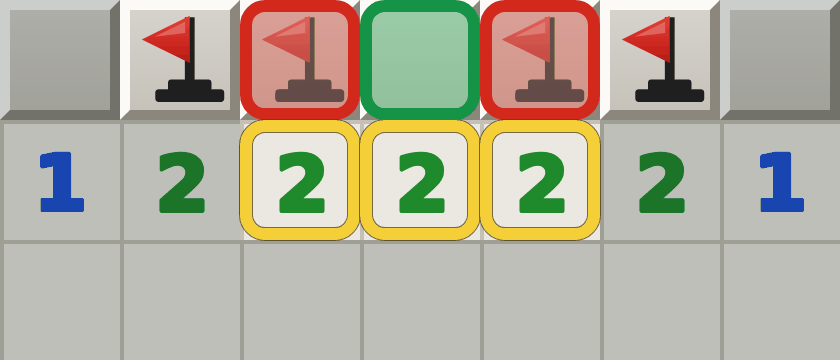
The short version. The patterns you'll use most are the 1-1, the 1-2, the 1-2-1 and the 1-2-2-1. Along a straight edge, with the closed squares above the numbers, a 1-2-1 has its mines directly above the two 1s and a 1-2-2-1 has its mines directly above the two 2s. The other squares those numbers touch are safe.
How to read the pictures
The pictures on this page use the same marks as the Hint button in our game:
- A gold ring marks the numbers that give the answer away.
- Red squares are mines. Flag them.
- Green squares are safe. Open them.
- A dashed edge shows where a number's mine must be hiding, though the ringed numbers can't tell you which square it is.
In each pattern the row below the numbers is already open. That's what makes it work: the closed squares above the numbers are the only place their mines can be. On a real board the same shapes turn up facing any direction.
Start with the two basic rules
Every pattern is built on two simple rules, so get these down first.
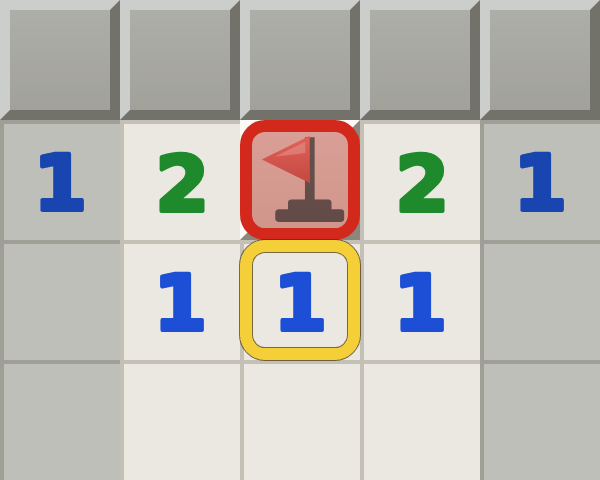
Rule 1: a number with just enough closed squares
If a number touches exactly as many closed squares as its value, all of them are mines. A 1 with one closed neighbor, a 2 with two, a 3 with three.
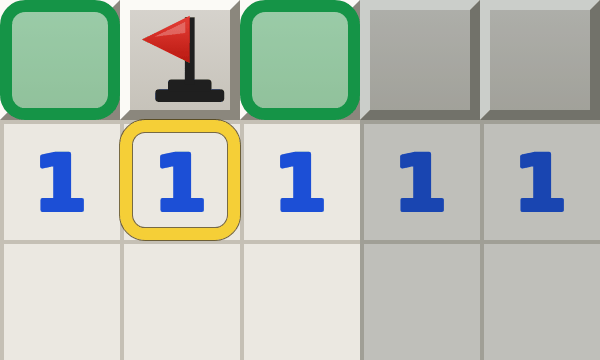
Rule 2: a number with all its flags
If a number already touches as many flags as its value, every other square around it is safe. Click the number to open them all at once.
You can clear most Beginner boards with these two rules alone. The patterns below are for the moments when they don't help.
The 1-1 pattern
Two 1s side by side, with the first one against the wall of the board. The first 1 has two closed squares above it, and one of them is a mine. The second 1 touches those same two squares plus one more. It already gets its mine from the first two, so the third square is safe.
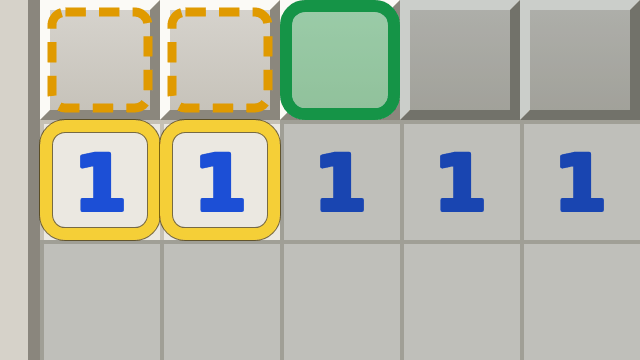
The wall isn't really the point. It works wherever all the closed squares around one 1 also touch a second 1. Any extra squares the second 1 touches are then safe.
The 1-2 pattern
Now a 1 next to a 2, again along the wall. The 1 has one mine among its two closed squares. The 2 sees those same two squares plus one more. It needs two mines, but the shared squares can only give it one. So the third square must be a mine.
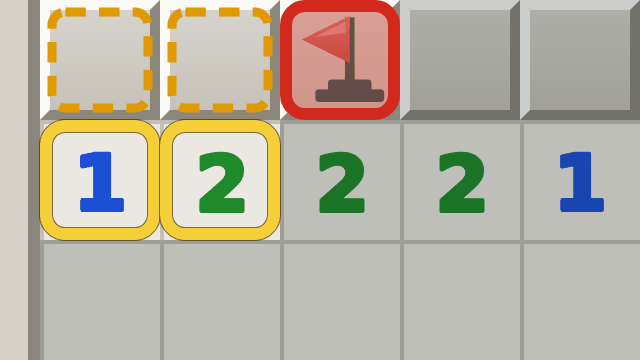
Away from the wall the same pattern tells you even more. The square past the 2 is a mine, and the square on the far side of the 1 is safe.
The 1-2-1 pattern
This is the classic. Three numbers in a row along a straight edge: 1, 2, 1. The mines are always directly above the two 1s. The square directly above the 2 is safe, and so are the squares diagonally outside each 1.
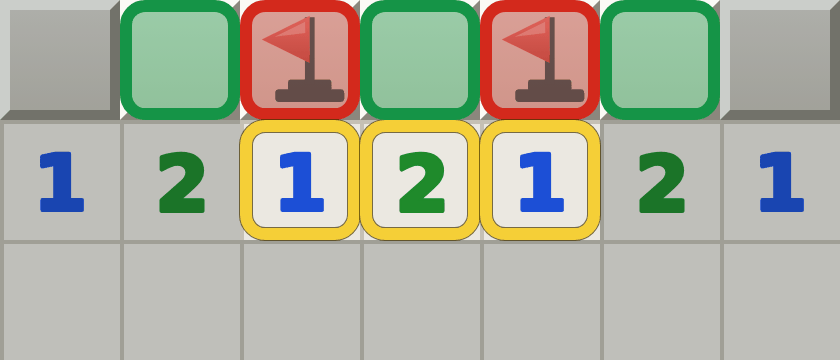
Why does it work? Look at the first 1 and the 2 together. That's a 1-2, so the square past the 2 is a mine. Do the same from the other side and you find the second mine. The 2 now has both of its mines, so the square in the middle is safe.
The 1-2-2-1 pattern
The longer cousin: 1, 2, 2, 1 along a straight edge. This time the mines are directly above the two 2s. The squares directly above the 1s are safe, and so are the ones diagonally outside them.
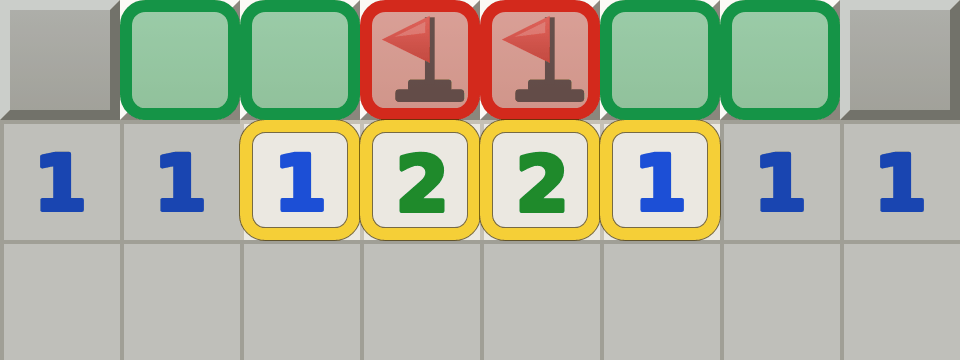
It's the same trick as before. The 1-2 on the left puts a mine above the second 2, and the 1-2 on the right puts one above the first 2. An easy way to remember both: in a 1-2-1 the mines go with the 1s, in a 1-2-2-1 they go with the 2s.
The 2-1-2 pattern
A 1 between two 2s along a straight edge. One mine sits directly above the 1, and the other two sit on the outside, diagonally beyond each 2. The squares directly above the 2s are safe.
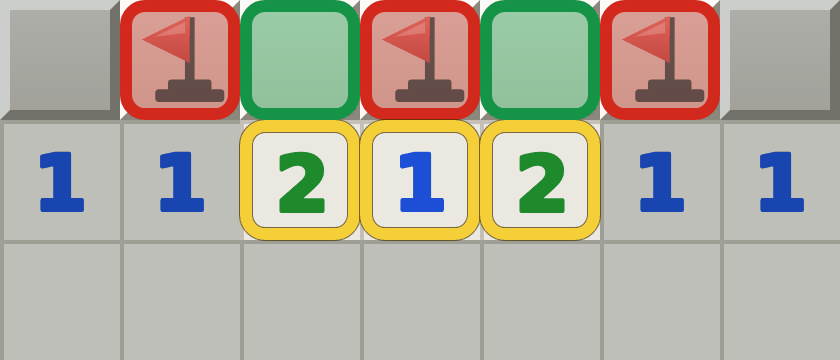
Here's the reasoning. Each 2 shares two squares with the 1, and the 1 has only one mine to give. So each 2 needs a mine on its outer square. Both 2s still need one more mine from the squares they share with the 1, and the 1 can only afford one. It has to be the square all three numbers share: the one directly above the 1.
The 2-1-1-2 pattern
Two 1s between two 2s, along a straight edge. The mines come in pairs here: two at the left end (directly above the first 2 and diagonally outside it) and two at the right end. The squares directly above the two 1s are safe.
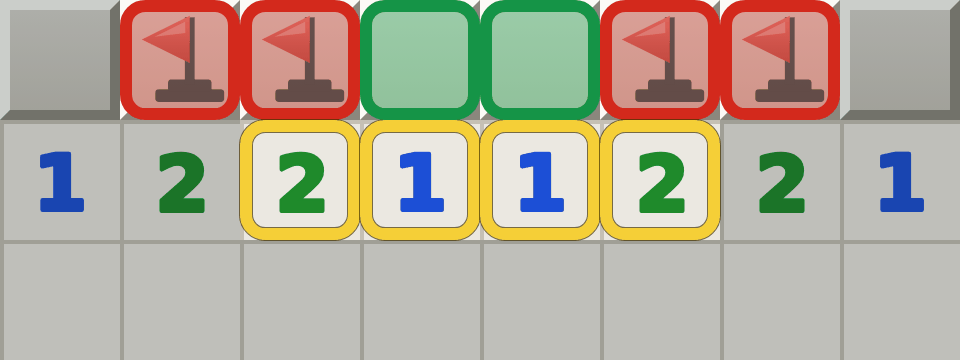
Why? Each 2 and the 1 beside it work like a 1-2, so the square diagonally outside each 2 is a mine and the squares above both 1s are safe. That leaves each 1 just one place for its mine: the square above the 2 next to it.
Subtract the flags first
Patterns love to hide behind flags. Before you look for one, subtract the flags each number already touches. A 2 next to one flag is really a 1. A 3 next to two flags is really a 1 as well.
Once you get used to this, you'll see 1-2-1s and 1-1s everywhere, even where the board shows 3s and 4s.
Strategy tips to win more games
Compare two numbers
When no single number helps, compare two neighbors. If one number sees everything the other sees plus a few extra squares, the difference between their values is exactly the number of mines in those extra squares. Every pattern on this page is that same idea in a familiar shape.
Start at the edges and corners
Squares along a wall have fewer neighbors, so the numbers there tell you more. A corner square has only three.
Use the mine counter near the end
When only a few squares are left, the counter can settle things. If it reads 0 and all your flags are right, every square without a flag is safe. If it reads 1 and there's only one square left that could hold a mine, you've found it.
Don't flag what you don't need
Every flag costs a click. Many top players skip flags altogether and only open the safe squares. While you're learning, flag freely. It makes counting a lot easier.
Your first click
On this site it doesn't matter where you start: the first click always opens an area. In versions where the first click is only guaranteed to be safe, a corner is the most likely square to open an area, because it has just three neighbors that need to be free of mines.
If you must guess, guess early
In the classic game some boards can't be solved without a guess. If you have to take a chance, take it early rather than after five minutes of careful play. And compare the odds: a square in a quiet part of the board is often a safer bet than a 50-50 next to the numbers. Our boards never force a guess, and here's how no-guess Minesweeper works.
Let the hint teach you
Stuck in our game? Press Hint. It marks the next move with the same colors as the pictures above and tells you why it works. After a few games you'll spot the shapes yourself.
Questions and answers
What is the most common Minesweeper pattern?
The 1-1 and the 1-2 come up all the time, often several times in one game. The 1-2-1 is usually the first one people learn, because it's so easy to spot along a straight edge.
Is there a strategy that always wins?
Not in classic Minesweeper. Some boards simply can't be solved without a guess. With the patterns and some careful counting you'll win nearly every board that can be solved, and on this site all of them can.
Do these patterns work in Google Minesweeper?
Yes. The rules are the same in every version, so the patterns are too. Only the board sizes differ. More about Google Minesweeper.
What's the difference between a 1-2-1 and a 1-2-2-1?
Where the mines go. With the closed squares above the numbers, a 1-2-1 has its mines directly above the 1s and a 1-2-2-1 has them directly above the 2s.
Do I have to learn all these patterns?
No. Start with the two basic rules and the 1-2-1. The rest will come naturally as you play, especially if you use the Hint button now and then.
Try the patterns on a real board.
Play Minesweeper