No-guess Minesweeper
Every board on this page can be cleared with logic alone. No coin flips, no 50-50 on the last two squares and no winning streak lost to bad luck.
Play no-guess MinesweeperIs Minesweeper luck? In the classic game, partly. The mines are placed at random, so some boards leave you without a single safe move and you have to guess. On Expert that happens in about four out of five games, even for a perfect player. Here every board is checked before you play, so it's all skill.
Why classic Minesweeper makes you guess
In most versions of Minesweeper, the mines are simply thrown onto the board at random. Usually the numbers give you enough to go on. Sometimes they don't.
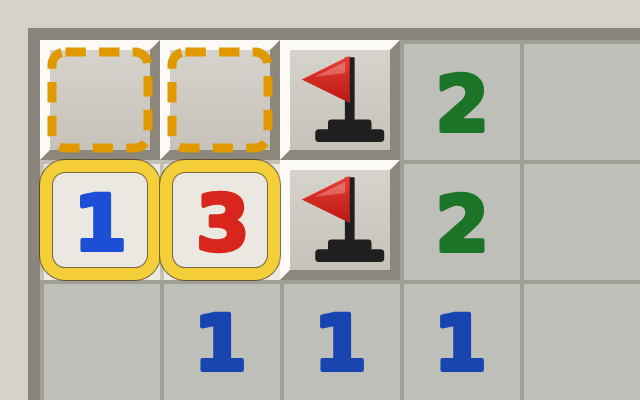
A spot like this is called a 50-50. Both squares are equally likely to hide the mine, and no amount of skill gets you through. You click and hope.
It doesn't have to be two squares, either. Sometimes the numbers run out halfway through a game and every closed square is a gamble. Experienced players learn to pick the best odds, but it's still a gamble.
How often do you have to guess?
More often than you might think. We generated well over a thousand random boards for each level and ran them through a solver that never misses a logical move. It uses everything a perfect player could: every number, every combination of numbers and the mine count. The first click always opened an area, just like here.
| Level | Board | Needs at least one guess |
|---|---|---|
| Beginner | 9 × 9, 10 mines | about 8% of boards |
| Intermediate | 16 × 16, 40 mines | about 26% of boards |
| Expert | 30 × 16, 99 mines | about 83% of boards |
So on Expert, even a flawless player would have to guess in about four out of five games. In versions where the first click is only guaranteed to be safe, without an opening, it's even more.
That's why a good Minesweeper player can still lose a lot of games. It also explains why those losses so often come at the very end: the last few squares are where the numbers run out.
How we make sure you never have to guess
On this site the mines are placed after your first click. Then, before you see anything, the game plays the whole board itself. It only uses the kind of logic you can use too: what each number tells you, and what neighboring numbers tell you together. If it gets stuck anywhere, it throws the board away and makes a new one.
All of that takes a fraction of a second, so you won't notice it. What you get is a random board like any other, minus the ones that would force a guess.
That means two things for you:
- If you're stuck, there is a safe move. Keep looking, or press Hint and the game shows you where it is and why.
- If you lose, it was a mistake, not bad luck. Annoying, but you can learn from it.
Our Google Minesweeper page works the same way, with Google's board sizes.
Is every Minesweeper board solvable?
No. In the classic Windows game and in Google's version the mines are random, so as the table above shows, many boards need at least one guess.
Minesweeper is also a hard problem in the mathematical sense. In 2000 a paper in The Mathematical Intelligencer showed that Minesweeper is NP-complete. Put simply: as boards grow, checking whether a position is even possible gets out of hand fast, as far as anyone knows. Boards the size of Expert are no problem in practice, though. Our solver checks one in less than a millisecond.
What to do when you have to guess
On this site you never will. But if you play other versions, these habits save a lot of games:
Make sure you really have to
Before you guess, check every pair of numbers along the edge and look at the mine counter. Most "guesses" turn out to have a logical answer after all. Our pattern guide helps you spot them.
Guess early
If a guess can't be avoided, take it as soon as you know. Losing after ten seconds hurts a lot less than losing after five minutes.
Pick the best odds
Not every guess is a 50-50. A closed square in a quiet part of the board, away from the numbers, is often a safer bet. On a fresh Expert board about one square in five is a mine, so a random square there has roughly an 80% chance of being safe.
Choose a guess that helps
If two squares have the same odds, pick the one that will tell you the most when it opens. A square next to other closed squares can open up a new area, while a square boxed in by numbers rarely helps you further.
Questions and answers
Is Minesweeper luck or skill?
Mostly skill, with some luck in the classic game. Skill decides whether you find every logical move, and luck decides how often the board leaves you without one. On this site the luck part is gone.
Does no-guess make Minesweeper easier?
It makes it fairer, not easier. You still need to find every move yourself, and Expert boards still take some serious thinking. You just never lose to a coin flip.
Do you ever have to guess in Minesweeper?
In the classic game, yes, quite often on the bigger boards. Here, never. Every board can be solved from the first click to the last square.
Is Google Minesweeper no-guess?
Not as far as we know. Google's boards are random, so you'll sometimes hit a 50-50. You can play the same board sizes without guessing on our Google Minesweeper page.
Why do I keep getting stuck at the end?
In the classic game the last few squares are where guesses pile up, because there are fewer numbers left to help you. On this site there's always a logical move, even at the very end. Compare two neighboring numbers, or press Hint.